

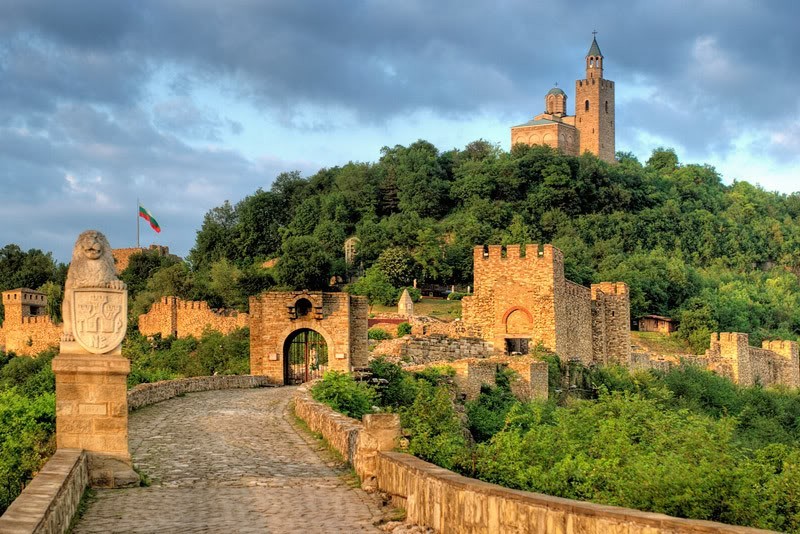
K Tsarevets Fortress is located in Veliko Tarnovo, the third capital of Bulgaria (1185-1193) after Pliska and Preslav. The city has two naturally fortified mountains - Trapezitsa and Tsarevets with the residence of the king and the Bulgarian patriarch. Today you can see the fortress walls, towers, gates and churches. In the lights of the project "Light and Sound" Tsarevets with all its buildings looks fantastic
After 1185, Bulgaria was successfully rising after the overthrow of Byzantine rule. The liberation leaders tried to liberate the previous capital Preslav, but lost the battle. Therefore, they proclaimed Tarnovo as the new capital of the liberated state. This was not a random choice - the place had an important strategic importance, and was naturally fortified. Located at an important crossroads, the city of Veliko Tarnovo played a key role in Bulgaria's struggle against Byzantium. The Bulgarian ruler gathered all the power in the state, all the levers of power were concentrated in the palace of the king, located on the fortified mountain Tsarevets. All administrative, military, intellectual and religious affairs were conducted here, diplomatic activity developed, it was the economic center of the state. The whole life of the city was built around the king's residence
In 1235 the Patriarchate of Constantinople allowed Bulgaria to reestablish the church. The proof of the importance of the church was that the residence of the Patriarch was located on top of the royal mountain Tsarevets. The Patriarchal complex still stands on the highest terrace of Mount Tsarevets, south of the palace of the Bulgarian king. The complex symbolizes the strength of the Christian Church, inspires and brings respect for the faith. This complex includes an inner courtyard, around which different buildings for different purposes are located - houses, refectories, administrative buildings, a library and a room for manuscripts. The whole complex covers an area of 1413 square meters. Unlike other monastic complexes near Tarnovo, the Patriarchate has protective walls - a strong structure that matches the configuration of the terrain. After the Turkish takeover of Bulgaria, Tsarevets was forgotten and neglected, and only came back to life thanks to archaeologists and restorers as part of the 1300 years of history of Bulgaria and the Bulgarian people.


